

Launch at Dubai boat show
Shrouded in secrecy until her launch in Dubai, the GTCat 66 is a ground-breaking yacht: the world’s fastest luxury sailing catamaran for her size.
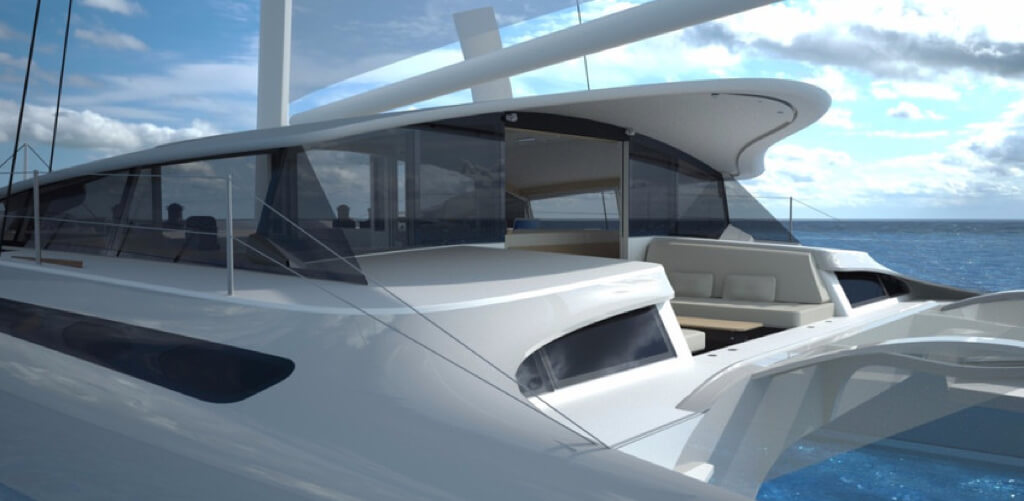
For eight years, the GTCat 66 was the consuming passion of its Dubai-based founders. In conceiving the yacht, they enlisted several of the world’s leading specialists, including multihull designers Nigel Irens and Benoît Cabaret and industrial designer Christophe Chedal Anglay. The boat was built using the latest technologies, including full-carbon Applied Structural Analysis design.
The group created a state-of-the-art, 20-metre racing catamaran with an ultra-lightweight interior and a high specification. The result is a tamed racing yacht that is ultra-fast, luxurious and spacious. She has four cabins and a saloon area comparable to that of a much larger monohull. If pressed, she can fly her weather hull like a racing catamaran in 12 knots of breeze and reach 20 knots.
Part of the secret to the boat’s performance is that, like the Irens-Cabaret record-breaking trimarans of the previous decade, the GTCat 66 has very slim hulls and is long for her beam. Long, slender hulls have less wave-making drag. Her bows are wave-piercing, while the hulls have a chine running their length that helps shed water and provides structural stiffness.
The GTCat 66 is best considered a 16.5-metre boat in terms of beam and accommodation, extended by three metres. Making the hulls longer gives a multihull a better ride, more comfort, greater speed and safety. It should also pitch less and stay drier because it parts the sea more gently.
A secondary effect of the boat’s narrow beam is low weight, which is vital to high multihull performance. The GTCat 66 displaces just 11.5 tonnes, several tonnes less than other high-performance cruising catamarans. This is further helped by her carbon-fibre construction, low freeboard and lack of a forward crossbeam. The forestay instead tacks to the bowsprit, with trampoline on either side. Lightweight trampoline is also used at the aft end in place of solid deck.
Several features stem from the founders’ sailing background in A-Class dinghy catamarans. The boat has a state-of-the-art rotating wing mast and giant, curved A-Class-style foils, with the leeward board providing increased lift as the boat heels.
The steering positions are designed for the purist sailor. The cockpit is immediately forward of the main cabin, with a steering position at each lateral extremity. From the weather steering position, the helmsman can feel the wind, check the trim of every sail, see the leeward bow and control the hydraulic winches by push button. Each position uses a tiller rather than a wheel. The open saloon lets the skipper remain part of life on board while sailing.
For passengers, the large open-plan saloon offers a 360-degree panoramic view and includes a dinette to starboard and galley to port. Large patio doors at either end provide access forward to the cockpit and aft to further seating and sun loungers. The layout is ideal at anchor in warmer climates, and the boat can also be helmed from inside on longer passages.
Passageways from the saloon lead down to the main aft cabins in the hulls. The standard layout has an owner’s cabin aft in the starboard hull with a head compartment amidships, mirrored in the port hull. Single-berth cabins forward in each hull are accessible from both the hull and the deck.
The yacht began as a design for its owners’ own pleasure after they could not find a builder or boat that matched their expectations. They wanted a fast racing experience that could also be shared with friends without extensive sailing experience. The resulting design became an evolution of multiple generations of multihulls, innovative enough to put into production.
For owners seeking racing-multihull performance under sail and luxurious accommodation at rest, the GTCat offers an exceptional combination of performance and pedigree.