

The Boat
The GTCat 66 is a ground-breaking new breed of catamaran, designed to provide high-performance sailing sensations while remaining comfortable and easy to handle.
It is a tamed racing catamaran with an ultra-lightweight interior and a high specification, meant to fly a hull in 12 knots of wind.
Its long, slender hulls minimize drag and enhance stability.
Design
The GTCat 66 was designed by world-leading multihull specialists Nigel Irens and Benoît Cabaret. Part of the secret to the boat’s performance is that, like the Irens-Cabaret record-breaking trimarans of the last decade, the GTCat 66 has very slim hulls and is long for her beam. Long slender hulls have less drag, a fundamental philosophy Nigel has pushed throughout his career designing multihulls.
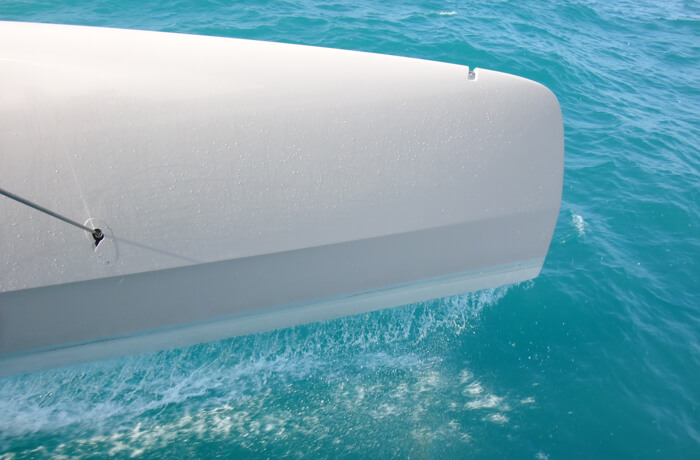
The GTCat’s bows are wave-piercing, while the hulls have a chine running their length that helps shed water and also provides structural stiffness.
Styling
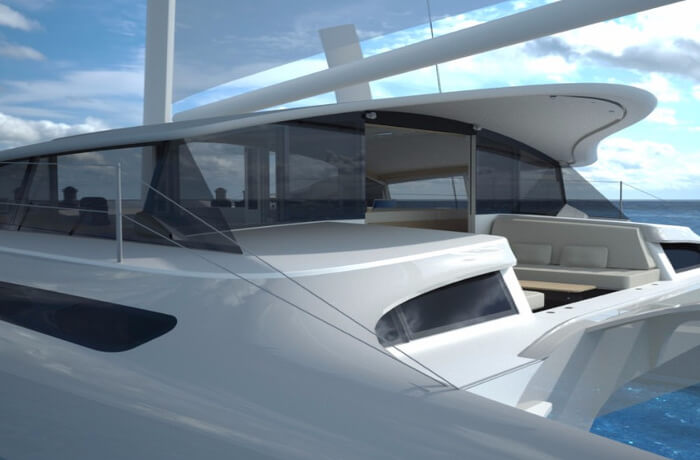
The styling was created by Christophe Chedal Anglay, one of Europe’s leading industrial stylists, who oversaw the boat’s aesthetics. Anglay and Irens combined a high-performance boat with a pure design touch.
Rig
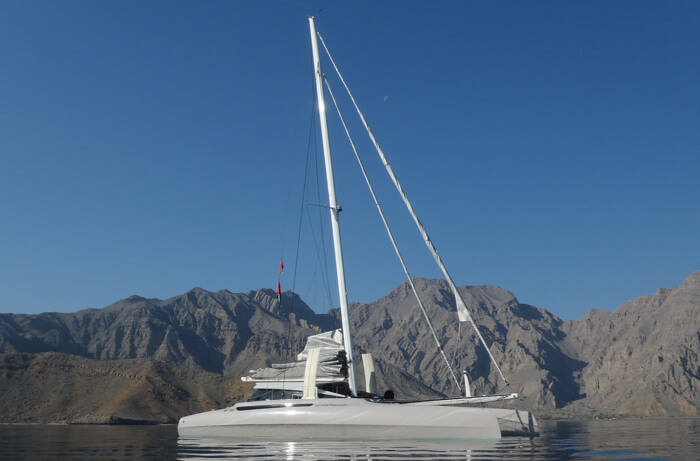
The mast is a full-carbon rotating wing mast designed by Future Fibres in collaboration with North Sails, using their computational fluid dynamics tools.
It has a simple, clean single-spreader geometry with spreaders raked upwards, avoiding the typical droopy look of swept spreaders on a mast set with a large degree of rake.
A hydraulic cunningham allows quick adjustment of sail shape, reducing the need for reefing manoeuvres. Under deep reef, the mast is supported longitudinally by upsized diamond stays rather than a staysail. Future Fibre rigging is significantly smaller in diameter than competing systems for a given stiffness, so this could be achieved without increasing weight or drag.
To simplify rig setup, the mast has a unique feature: rather than turnbuckles on the diamonds and cap shrouds, it uses what is believed to be the first mast jack for a rotating mast. This contributes to an unusually tight dock tune of the diamond stays, which stabilizes the rig.
Daggerboards
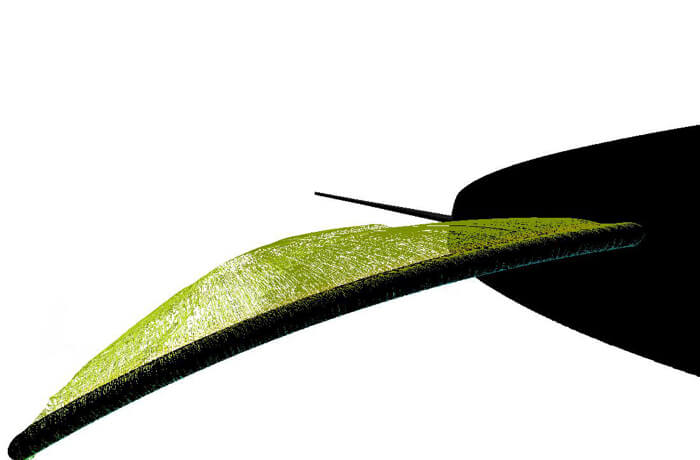
The boat has asymmetric foils that significantly enhance performance. At 12 knots of speed, the foil provides three tonnes of upward lift, reducing the apparent weight of the boat by lifting the leeward hull.
This reduces drag, enhances performance and gives much better feedback at the helm.
Sails
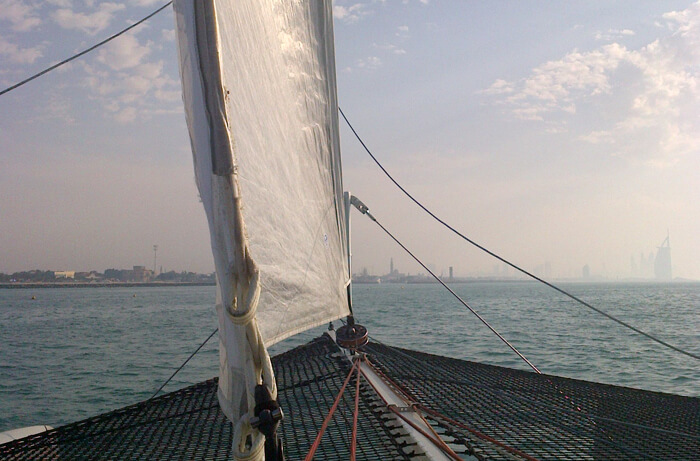
The sails were designed by North Sails using their proprietary software for optimum performance. This enables a minimum number of sails to be carried on board and provides a simple, lightweight setup. The sails cover a wide range of wind speeds and angles.
Cuben Fibre was chosen for all sails due to its durability and light weight, both crucial for a high-performance multihull.
- A 135 m² mainsail with three reefs and seven full battens
- A 60 m² self-tacking furling jib with vertical battens
- A 190 m² free-luff furling gennaker
Equipment
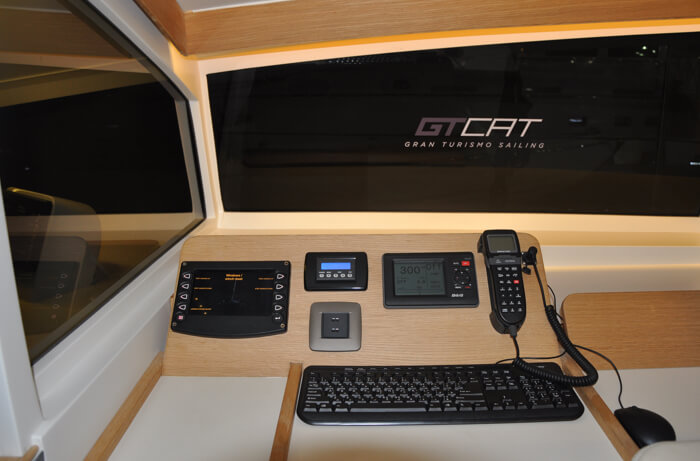
With the GTCat, we strive to provide the best possible equipment for the most enjoyable sailing experience.
Comfort
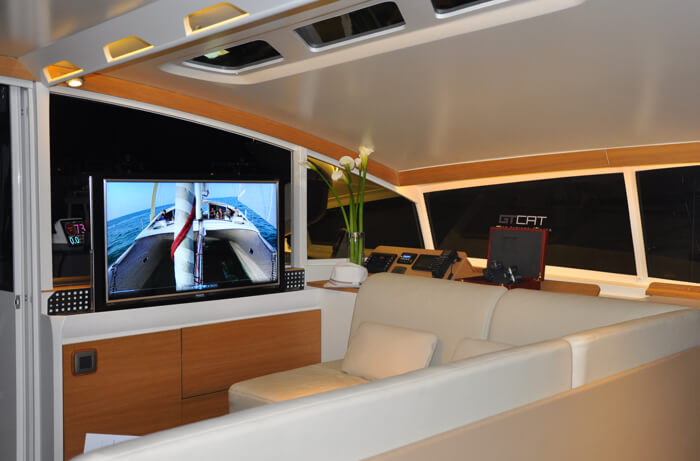
A large open-plan saloon area provides a 360-degree panoramic view, with a dinette to starboard and galley to port. Large patio doors at either end of the cabin provide access forward to the cockpit and aft to further seating and sun loungers on the aft deck. Passageways from the saloon lead down to the main aft cabins in the hulls. The standard layout has an owner’s cabin aft in the starboard hull with a head compartment amidships, mirrored in the port hull. Single-berth cabins forward in each hull are accessible from both the hull and the deck.
Specifications
- Construction
- Full carbon infusion
- Upwind Sail
- Area 195 m²
- Downwind Sail
- Area 325 m²
- Length
- 20.0 m (66 feet)
- Width
- 8.0 m (26 feet)
- Light ship
- 11.5 t
- Full load
- 12.5 t
- Mast
- 26 m
- Daggerboards
- Asymmetric foils
- Architect
- Nigel Irens